
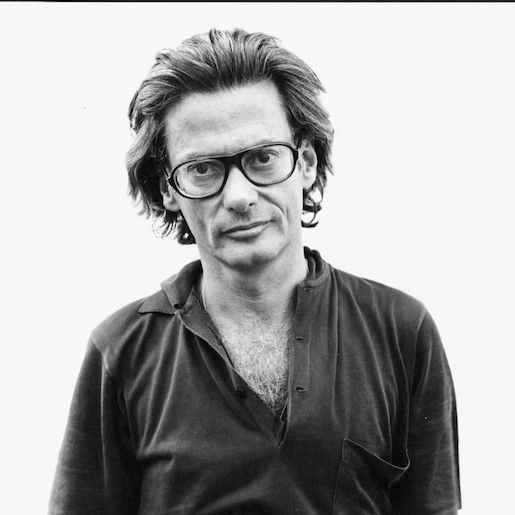
Richard Avedon
 American
|

Richard Avedon was born and raised in New York City, where his lifelong fascination with photography began early. At twelve, he joined the Young Men’s Hebrew Association (YMHA) camera club, and while attending DeWitt Clinton High School in the Bronx, he co-edited the literary magazine The Magpie with his classmate James Baldwin. In 1941, he was named Poet Laureate of New York City High Schools — a distinction that reflected the introspective and expressive sensibility that would later define his photographic work.In 1942, during World War II, Avedon enlisted in the U.S. Merchant Marine as Photographer’s Mate Second Class. His assignment was to take identification portraits of sailors, an experience that sharpened his technical skill and deepened his understanding of human expression. “My job was to do identity photographs,” he later recalled. “I must have taken pictures of one hundred thousand faces before it occurred to me I was becoming a photographer.”After two years of service, Avedon left the Merchant Marine to pursue photography professionally. He studied under art director Alexey Brodovitch at the Design Laboratory of the New School for Social Research, and soon began creating fashion photographs that broke convention. At twenty-two, he became a freelance photographer for Harper’s Bazaar, shooting fashion on city streets, beaches, and other unexpected settings when denied a studio. His inventive compositions and instinct for storytelling quickly earned him recognition as the magazine’s leading photographer.From the outset, Avedon also pursued portraiture, contributing to Theatre Arts, Life, Look, and Harper’s Bazaar. He was fascinated by photography’s ability to reveal personality through surface detail — posture, gesture, and attire — rather than psychological excavation. “My photographs don’t go below the surface,” he once remarked. “I have great faith in surfaces. A good one is full of clues.” His work redefined the portrait as both performance and revelation.In 1965, after guest-editing a controversial issue of Harper’s Bazaar that featured models of color, Avedon left the magazine and joined Vogue, where he worked for over two decades. In 1992, he became the first staff photographer at The New Yorker, bringing his distinctive visual language to the magazine’s modern identity. During this time, his fashion photography appeared almost exclusively in the French publication Égoïste.Alongside his editorial work, Avedon maintained a thriving commercial studio and helped dissolve the boundaries between art and commerce. His collaborations with Calvin Klein, Revlon, Versace, and other major brands produced some of the most memorable advertising campaigns in American history. The success of his commercial projects afforded him the freedom to undertake deeply personal and socially engaged series, including portraits of civil rights activists, antiwar figures, and his own father, Jacob Israel Avedon. His 1976 Rolling Stone portfolio “The Family” captured the political elite of America’s bicentennial era, while his monumental project In the American West (1979–1985), commissioned by the Amon Carter Museum of American Art, offered a raw, unflinching portrait of working-class America.Avedon’s career was marked by critical acclaim and widespread institutional recognition. His first museum retrospective was held at the Smithsonian Institution in 1962, followed by major exhibitions at the Metropolitan Museum of Art (1978, 2002), the Minneapolis Institute of Arts (1970), the Amon Carter Museum (1985), and the Whitney Museum of American Art (1994). His publications further cemented his influence, including Observations (1959, with text by Truman Capote), Nothing Personal (1964, with James Baldwin), Portraits 1947–1977 (1978, with Harold Rosenberg), An Autobiography (1993), Evidence 1944–1994 (1994, with essays by Jane Livingston and Adam Gopnik), and The Sixties (1999, with Doon Arbus).Richard Avedon died on October 1, 2004, in San Antonio, Texas, after suffering a cerebral hemorrhage while on assignment for The New Yorker. During his lifetime, he established The Richard Avedon Foundation to preserve and advance his legacy. His work continues to shape the language of portraiture, fashion, and visual culture, bridging the gap between art and life through an unwavering belief in the expressive power of the human face.


