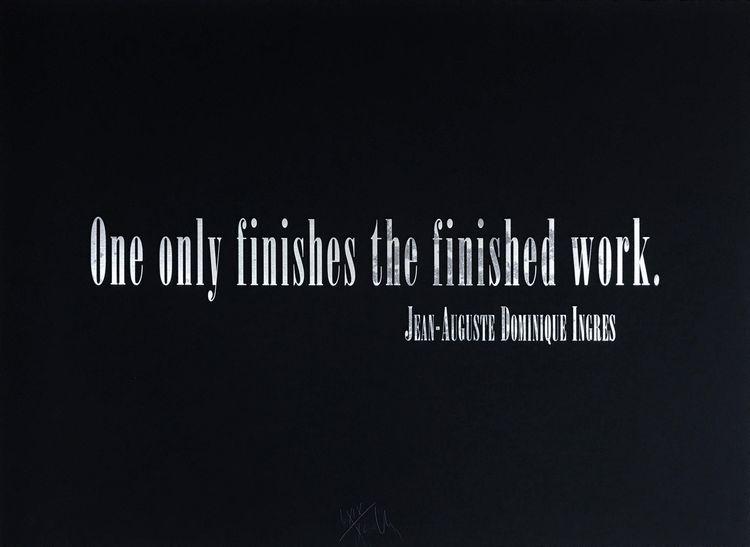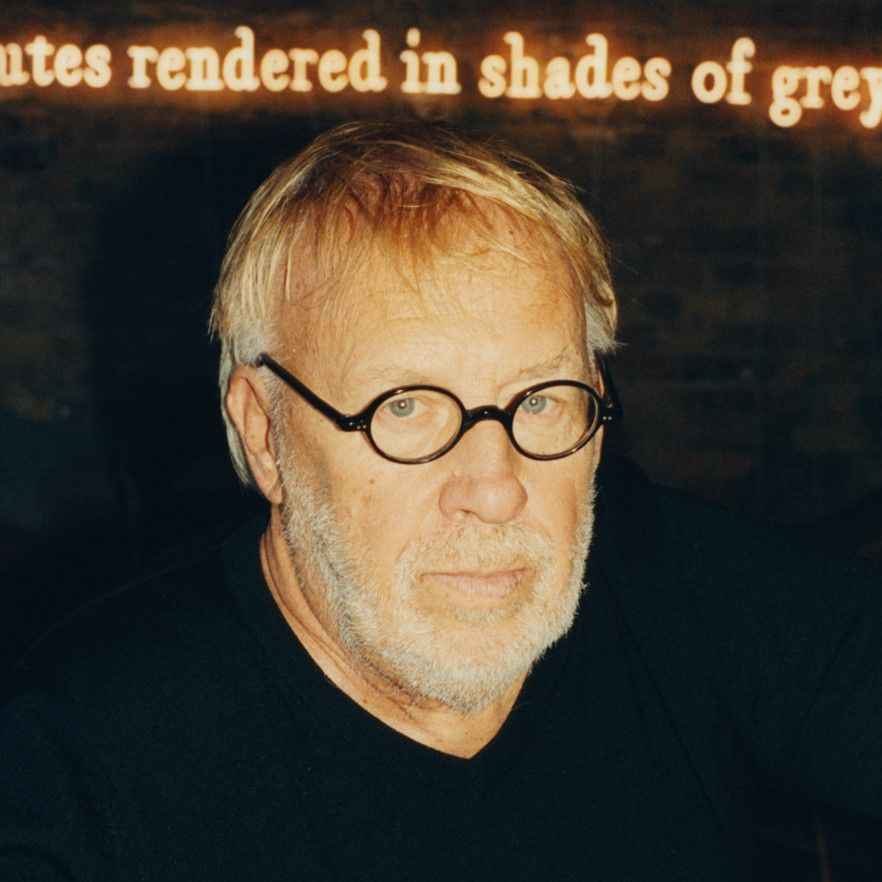


Joseph Kosuth is a seminal figure in the development of Conceptual art and installation art, internationally recognized for pioneering language-based practices and strategies of appropriation since the 1960s. For more than five decades, his work has rigorously examined how language produces meaning and how meaning functions within art itself.Born in 1945 in Toledo, Ohio, Kosuth studied at the Toledo Museum School of Design from 1955 to 1962 and trained privately with Belgian painter Line Bloom Draper. He continued his education at the Cleveland Institute of Art (1963–64) before studying with Roger Barr at the American Center in Paris (1964–65). In 1965, Kosuth relocated to New York to attend the School of Visual Arts, where he later joined the faculty. That same year, he decisively abandoned painting in favor of conceptual practice.Kosuth’s early conceptual works were first exhibited in 1967 at the Museum of Normal Art, an alternative exhibition space he co-founded. In 1969, he held his first solo exhibition at Leo Castelli Gallery, New York, and became the American editor of the influential journal Art & Language. From 1971 to 1972, he pursued studies in philosophical anthropology with Stanley Diamond and philosophy at the Graduate Faculty of The New School for Social Research. The writings of Ludwig Wittgenstein and other philosophers profoundly shaped his work from the late 1960s through the mid-1970s, reinforcing his sustained inquiry into the relationship between language, thought, and art.Kosuth’s investigations have taken the form of installations, museum exhibitions, public commissions, and publications presented throughout Europe, the Americas, and Asia. He has participated in documenta and the Venice Biennale on multiple occasions. He lives and works between New York and Venice.Over the course of his career, Kosuth has received numerous honors, including the Cassandra Foundation Grant (1968), the Brandeis Award (1990), the Frederick Wiseman Award (1991), a Menzione d’Onore at the Venice Biennale (1993), and designation as Chevalier de l’Ordre des Arts et des Lettres by the French government (1993). In 1999, the French government issued a postage stamp in his honor in Figeac. He received an honorary doctorate in Philosophy and Letters from the University of Bologna in 2001 and the Austrian Republic’s Decoration of Honour in Gold for services to the Republic of Austria in 2003. His installation ni apparence ni illusion opened at the Musée du Louvre in 2009 and became a permanent installation in 2014. He was inducted into the Royal Belgian Academy in 2012 and received the National Arts Club Medal of Honor in 2022. Most recently, he was awarded an honorary degree in Communication and Enhancement of Contemporary Art Heritage from the Accademia Albertina di Belle Arti in Turin.Kosuth’s work has been the subject of major solo exhibitions at institutions including the Multimedia Art Museum, Moscow; Kunstmuseum Thurgau, Warth; Haus Konstruktiv, Zurich; and the Australian Centre for Contemporary Art, Melbourne. In 2019, he completed permanent public installations at the Miami Beach Convention Center and the Bill Graham Civic Auditorium in San Francisco. His work is held in leading public and private collections worldwide, including the Museum of Modern Art, New York; Tate, London; the Solomon R. Guggenheim Museum, New York; the Whitney Museum of American Art; the Centre Pompidou, Paris; the Louvre; the Stedelijk Museum, Amsterdam; the Van Abbemuseum, Eindhoven; the National Gallery of Victoria, Melbourne; the Museum of Contemporary Art, Sydney; and the Galleria Nazionale d’Arte Moderna, Rome.