




Buy & Sell Damien Hirst Art




About Damien Hirst
Making order from uncertainty
Damien Hirst was born in Bristol in 1965 and raised in Leeds. He studied Fine Art at Goldsmiths, University of London, from 1986 to 1989. While still a student he organised Freeze in 1988, an artist-led exhibition in London. The participating artists were not yet known as the Young British Artists, since that label gathered force later, but the exhibition helped establish the independent conditions from which the group emerged.
The organising tension in his work is between the human appetite for order and the fact of death. Scientific display, pharmaceutical packaging and serial production all promise clarity. His arrangements rarely deliver it. They make uncertainty visible by giving it a structure, which is why a medicine cabinet and a tank holding an animal belong to the same practice. Both borrow the authority of institutions, then ask what that authority can actually settle.
The vitrine and the living image
The Natural History works use glass vitrines and preserved animals to place death in direct view. The Physical Impossibility of Death in the Mind of Someone Living (1991), with a tiger shark suspended in formaldehyde, turns a museum-like specimen into an encounter that is at once clinical and theatrical. In Mother and Child (Divided) (1993), a cow and calf are separated across four tanks, and the religious associations of the subject meet the cool language of scientific examination.
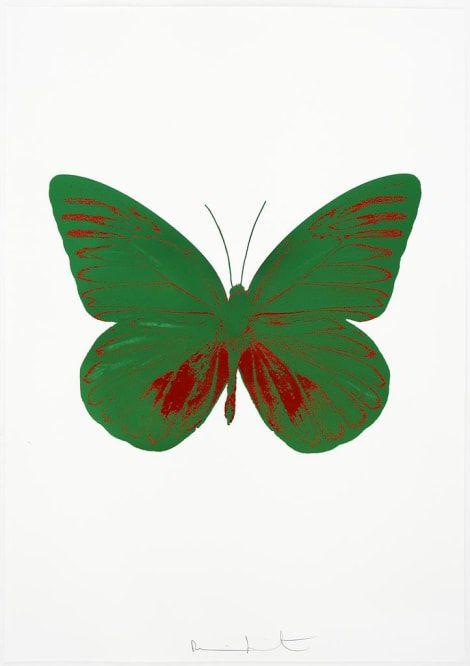
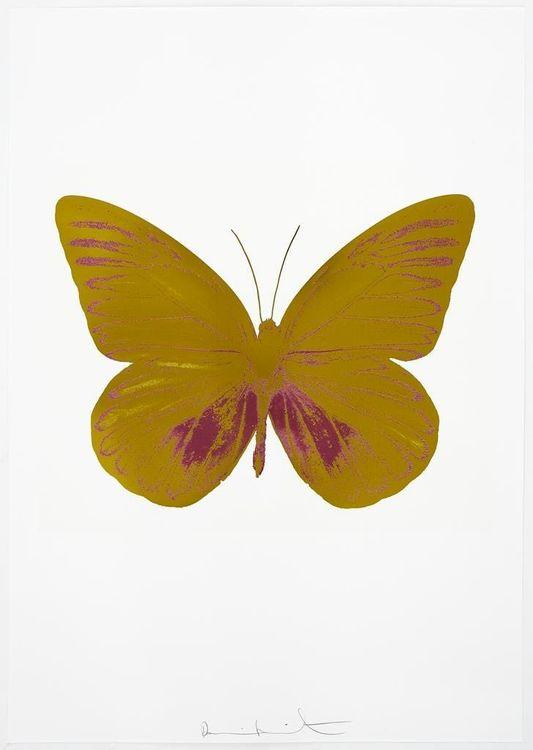
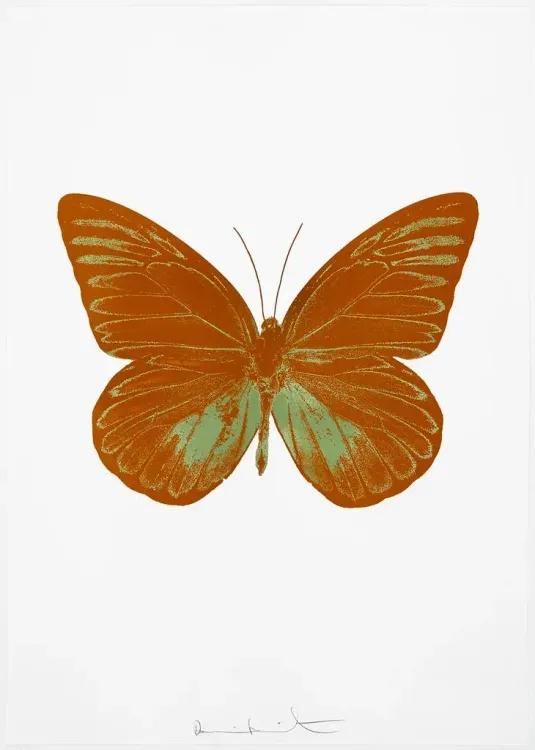
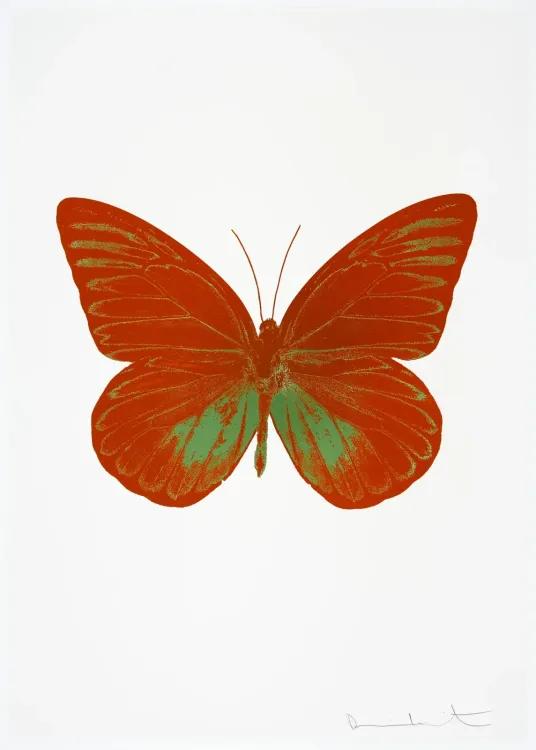
Other works make life itself unstable. Hirst's first solo exhibition, In and Out of Love (1991), used live butterflies, pupae and plants alongside canvases embedded with dead butterflies, compressing an entire life cycle into the gallery. The insect has returned constantly since. In the Kaleidoscope works begun in 2001, wings are arranged into radial patterns that draw directly on stained glass, and the 150 Psalms paintings of 2008 take their titles from Old Testament prayers.
The medicine cabinets developed from the late 1980s apply a related logic. Boxes and packets are arranged as if rational classification might hold illness at a distance. Their formal neatness echoes the belief invested in medicine, while the absence of bodies leaves that belief open to doubt. The Last Supper (1999) carries the same device into print: thirteen screenprints that adopt the visual conventions of drug packaging, with the medicine names replaced by ordinary British foods.
Rules, repetition and accident
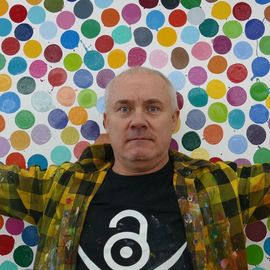
The Spot Paintings, begun in 1986, replace expressive gesture with evenly spaced circles, systematic colour and titles drawn from chemical compounds or pharmaceuticals. Their apparent impersonality is complicated by the fact that many were executed through Hirst's studio rather than by his hand alone. The series asks whether authorship rests in physical execution, in the rule that generates an image, or in the artist's control of a production system.
The Spin Paintings reverse that visual restraint. Made by applying paint to a rotating surface, they build centrifugal force into the process. Editions extend the same interest in repetition, and the releases Hirst has made with HENI, catalogued from H1 onwards, have become a substantial part of the work. Each takes an existing body of painting and translates it into a numbered series.
His later flower paintings bring control and excess together. The Cherry Blossoms, 107 canvases completed in 2020 after three years of work, invoke Impressionism, Pointillism and Action Painting without settling into any one of them. Thick brushstrokes and splashes make the series both a renewed engagement with the studio and a sustained test of decoration, abundance and painterly decision.
Belief after certainty
Hirst frequently approaches religion through material substitutes for faith. Away from the Flock (1994) presents a sheep in formaldehyde, activating the sacrificial associations of the lamb while withholding a stable devotional meaning. For the Love of God (2007), a platinum cast of a human skull set with 8,601 diamonds, joins the most durable signs of luxury to the form that makes individual mortality unmistakable.
In 2017, Treasures from the Wreck of the Unbelievable occupied both Palazzo Grassi and Punta della Dogana in Venice. Presented through a fictional account of an ancient shipwreck, its sculptures arrived with fabricated histories and the appearance of archaeological evidence. Seen alongside the earlier vitrines and cabinets, the project asks not simply whether an object is true, but what systems of display, narration and belief persuade an audience to treat it as true. The Currency put a version of that question to owners directly: 10,000 hand-made works on paper, each paired with a token, where every holder had to keep one and destroy the other.
Hirst won the Turner Prize in 1995, and Tate Modern staged the first substantial survey of his work in the United Kingdom in 2012. Animals, pills, spots, spins, flowers and precious materials are not a single visual style. They are different structures for testing how people live with knowledge that remains impossible to master.

Damien Hirst - Paper Blossoms (2023(
Collector & Guidance
Buying a Damien Hirst
Start with the exact object rather than the familiar image. Record the full title, date, medium, dimensions, series or H-code, edition size, edition type and publisher. A unique Spin Painting, a signed print and a laminated panel from a HENI edition may share imagery but require different checks.
Ask for clear images of the front, back, edges, signature, edition number, publisher label and any accompanying paperwork. Match the location and form of those details to the exact release. Documentation varies between Hirst editions: some HENI works carry a signed and numbered label, while others were issued without a separate certificate of authenticity. The absence of a certificate is therefore not decisive on its own, and a generic certificate should not override conflicting object details.
Condition assessment should follow the medium. Check paper for handling marks, creases, staining and fading; glossy, foil, glittered or laminated surfaces for scratches and abrasions; and frames for whether they are original to the release. Organic materials, sculpture and formaldehyde works require specialist advice and a documented conservation history. Establish provenance through original invoices, publisher or gallery records, labels and an intelligible chain of ownership, then use FairArt's authentication and money-back guarantee as part of the transaction checks rather than as a substitute for accurate cataloguing.
Selling a Damien Hirst
Provide enough evidence to identify the exact work before discussing a listing. Submit full front and back photographs, close-ups of the signature and edition number, publisher or gallery labels, H-code where relevant, edges and any condition issue. Include the invoice, certificate or publisher documentation if one was issued, together with original packaging and framing information.
State whether the work is unique, from the standard edition, or an artist's, printer's or other proof. Give framed and unframed dimensions and note any changes since acquisition, including reframing, restoration, fading, scratches or storage damage. For sculpture, organic material or formaldehyde works, provide installation, maintenance and conservation records. Precise cataloguing lets a buyer compare the right object and reduces avoidable questions during authentication.
Recognition
- Hirst was shortlisted for the Turner Prize in 1992 and won it in 1995.
- Mother and Child (Divided) was shown in the Aperto section of the Venice Biennale in 1993.
- The Last Supper was awarded the Grand Prize at the Ljubljana Biennial of Graphic Arts in 2001.
- Tate Modern presented a major survey of his work from April to September 2012.
- Treasures from the Wreck of the Unbelievable was presented across Palazzo Grassi and Punta della Dogana in Venice in 2017.
- Fondation Cartier pour l'art contemporain presented 30 paintings from Cherry Blossoms in Paris in 2021–22.
- His work is represented in public and institutional collections including Tate and the National Galleries of Scotland through ARTIST ROOMS, the Museum of Modern Art, the Metropolitan Museum of Art, the British Museum, the National Gallery of Art, the Art Institute of Chicago, the Yale Center for British Art, the National Gallery of Victoria, the British Council Collection, the Government Art Collection and The Broad.
Market & Collectability
Recent public results demonstrate why medium, date and exact edition matter more than the artist's name alone. On 24 June 2026, Phillips reported a published sale price of $122,550 for The Souls on Jacob's Ladder Take Their Flight (2007), against an estimate of $80,000–$120,000, and $41,280 for Methamphetamine (2004), against $20,000–$30,000. On 25 June 2026, Christie's reported £762,000 for the early butterfly painting I Love You (1994–95).
These auction-house figures are published sale prices and may include buyer's premium. They are not valuations for other works. Comparisons should be made between like-for-like examples, with attention to whether a work is unique or editioned, its precise series and edition, signature, publisher, provenance, condition and any specialist conservation requirements.
NOTABLE AUCTION RESULTS

The Golden Calf
FAQS
Why is Damien Hirst associated with the Young British Artists?
What do Damien Hirst's Spot Paintings mean?
What are the H numbers on Damien Hirst prints?
Did Damien Hirst win the Turner Prize?
Yes. He was shortlisted in 1992 and won the Turner Prize in 1995.
Does Damien Hirst make every work himself?
No. Many Spot Paintings were executed by assistants working within Hirst's studio, while he retained control over their system and production. This production model is not evidence by itself that a work is unauthorised. A buyer should verify whether the specific object accords with the documented method, publisher and edition.