
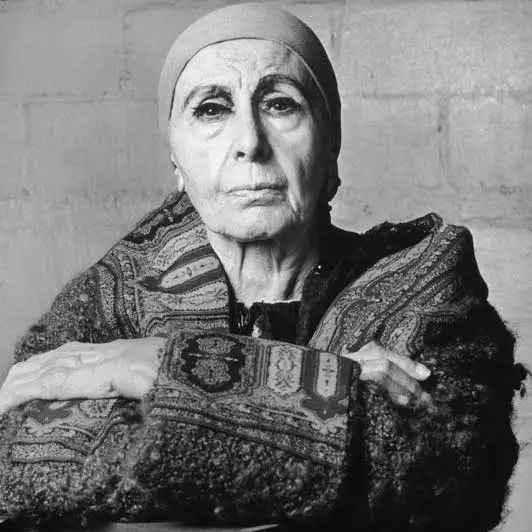


Louise Nevelson stands as one of the 20th century’s most celebrated sculptors and a pioneering force in large-scale installation art. Working with salvaged timber, furniture fragments, and wooden crates, she constructed monumental assemblages that draw on Abstract Expressionism, Cubism, and Constructivism while asserting a language entirely her own. Her sculptures—most often rendered in deep, unified black, with occasional departures into white, blue, or gold—redefined the relationship between object and viewer, moving beyond representation toward immersive, architectural presence.After studying with the influential painter and teacher Hans Hofmann, Nevelson began developing her signature sculptural forms in the mid-1950s. They were swiftly embraced by the art establishment: the Whitney Museum of American Art, the Museum of Modern Art, and the Brooklyn Museum each acquired major works before the decade’s end. Since then, Nevelson has been the subject of numerous solo exhibitions at leading institutions including the Whitney, the Los Angeles County Museum of Art, and the Guggenheim Museum. Her work remains highly sought after on the secondary market, achieving seven-figure prices. In addition to her sculptural practice, Nevelson was also a prolific painter, draftswoman, and collage artist, further underscoring the breadth of her artistic vision.

